



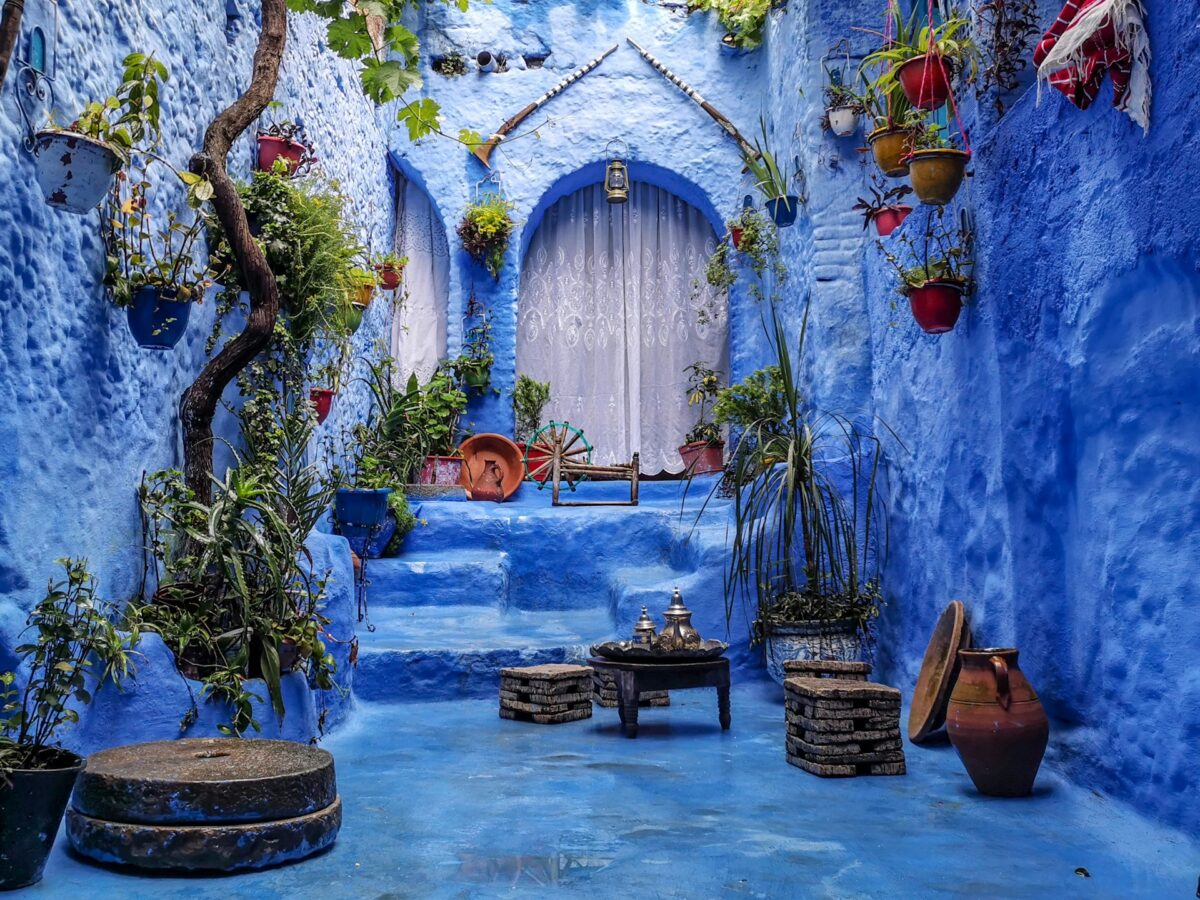

Morocco is one of the last great shopping destinations on earth — not for brands, but for things made by hand, often by the same families for centuries. In an age when almost everything can be ordered online and delivered tomorrow, the Moroccan medina offers something increasingly rare: objects with a maker, a place and a story, that you simply cannot buy anywhere else. The catch is knowing what is genuinely worth your suitcase space, and telling the real thing from the mass-produced imitation sitting right beside it. This is a guide to what to actually buy in Morocco — and how to bring home the real thing.
A word before you set off into the souk. Morocco’s crafts are living traditions, not tourist inventions — the same looms, kilns and tanning vats have been in use for centuries, and the finest pieces are extraordinary. But that authenticity sits side by side with a flood of imported, machine-made imitations aimed squarely at visitors in a hurry. Learning to tell them apart is half the pleasure, and it is what separates a drawer of forgotten knick-knacks from a few genuine treasures you’ll keep for life. Here is where to focus.
Rugs: The Heirloom Purchase
If you buy one thing in Morocco, make it a rug. Moroccan carpets are among the most collected textiles in the world, and each region weaves its own signature. The cream, diamond-patterned Beni Ourain from the Middle Atlas has become a design-world icon; the flat-woven, boldly coloured kilims and the shaggy, sequinned Boucherouite made from recycled fabric each tell a different story. A genuine hand-knotted rug is woven by a single woman over weeks or months, and no two are ever identical.
This is also the purchase where expertise matters most. The difference between a hand-knotted wool rug and a machine-made synthetic copy can be thousands of euros — and to an untrained eye they can look alike on the wall of a dim shop. Flip a real one over: the pattern shows through on the back, the knots are irregular, the wool smells of lanolin, not plastic. A genuine vintage piece will show gentle wear and the subtle colour shifts that come from natural dyes and decades of use. It is worth buying slowly, over the glass of mint tea that any serious dealer will press on you, and ideally with someone who can read the weave and knows roughly what a given size and region should cost. A good rug will outlive you; it is less a souvenir than an heirloom you happen to have bought on holiday.
Leather: From the Legendary Tanneries
Fez is home to the oldest working tanneries in the world, where hides are still cured in stone vats of natural dye exactly as they were a thousand years ago. The leather that comes out — soft, supple and deeply coloured — becomes babouches (the iconic pointed slippers), poufs, bags, jackets and bound journals. Buy the poufs unstuffed and flat-packed; they weigh almost nothing and you fill them at home.
Quality varies enormously. Good Moroccan leather is thick, evenly dyed and smells of leather, not chemicals; the stitching is tight and the soles of babouches are properly layered. Cheap versions crack within a season and bleed dye onto your socks. The tanneries themselves are worth seeing before you buy — standing on a terrace above the great honeycomb of coloured vats, a sprig of mint held to your nose against the smell, you understand exactly why real Moroccan leather carries the value it does. As with rugs, the best pieces rarely sit in the stalls aimed at day-trippers; they’re in the workshops a few streets back, where the person selling is often the person who made it.
Argan Oil: The Real Liquid Gold
Argan oil grows only in one place on earth: the argan forests of southwest Morocco, between Essaouira and Agadir. Produced by Berber women’s co-operatives who crack the nuts by hand, it comes in two forms — culinary (toasted, nutty, wonderful drizzled over food) and cosmetic (untoasted, for skin and hair). Pure argan oil is genuinely one of the finest natural products in the world, and buying it at the source, from a real co-operative, costs a fraction of what the same bottle fetches in a European pharmacy.
Beware the imitations: much of what’s sold to tourists is diluted or cut with cheaper oils. Real argan oil is sold in dark glass, has a short shelf life, and — in the cosmetic form — absorbs quickly without greasiness. A visit to a working co-operative, where you can watch the nuts being cracked, is both a wonderful experience and the surest guarantee of the real thing.
Exploring the souk with someone who knows it turns a daunting shopping trip into a confident one.
Ceramics and Zellige: Colour You Can Carry Home
Moroccan pottery is instantly recognisable — the deep blues of Fez, the green of Tamegroute glazed in a centuries-old desert kiln, the hand-painted tagines and bowls of Safi. Then there is zellige, the hand-cut geometric tilework that covers the walls and fountains of the great palaces, each tiny piece chipped by hand. Smaller zellige items — a side table, a mirror frame, a set of coasters — travel surprisingly well and bring a flash of that palace colour into a European home.
The things to check are simple: hand-painted pieces show slight irregularities and brushstrokes; transfer-printed copies are suspiciously perfect and uniform. For anything fragile, serious sellers will pack it properly for the flight, and the best can arrange shipping for the larger pieces you fall in love with but can’t carry.
Silver, Spices and the Smaller Treasures
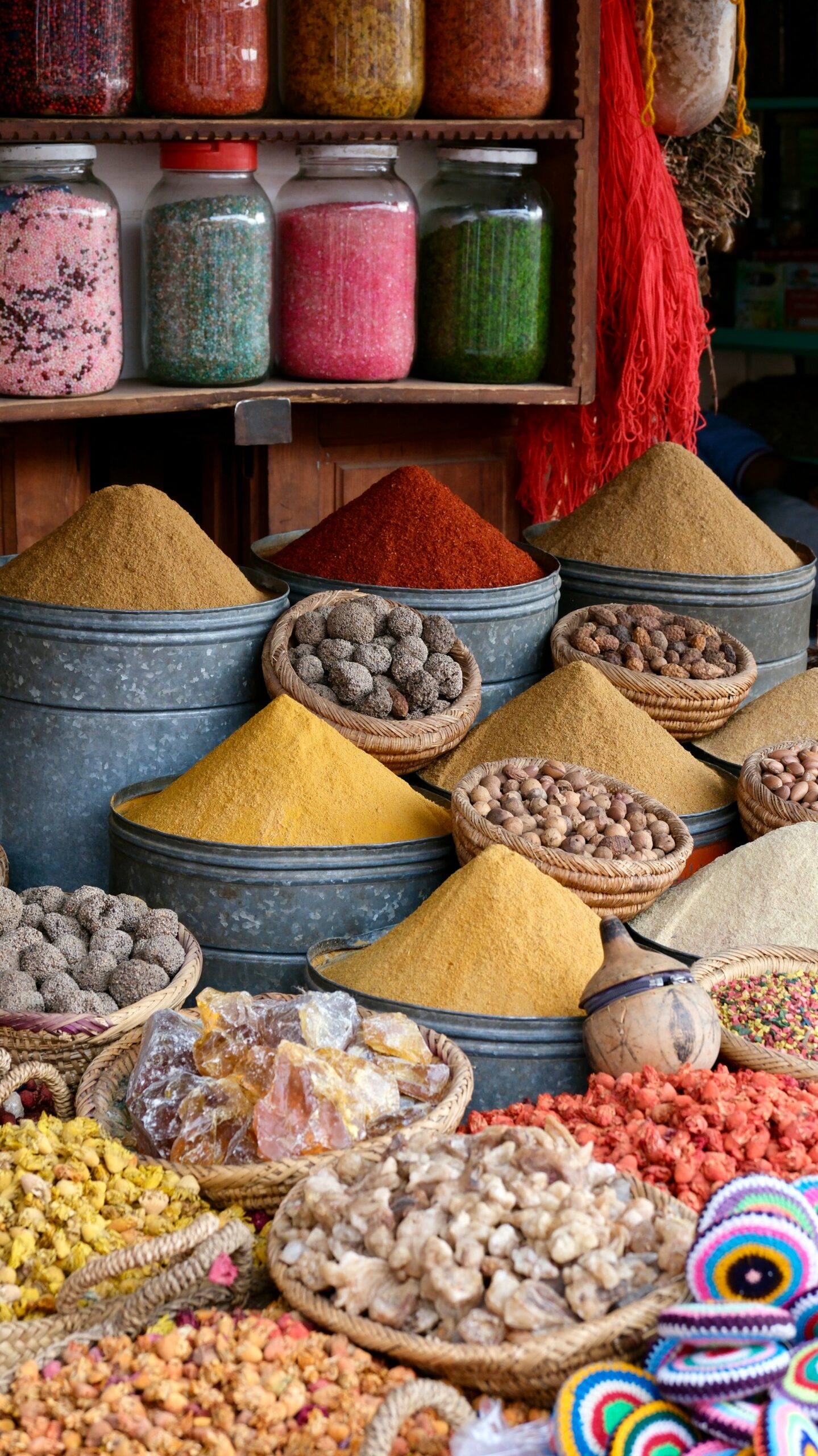
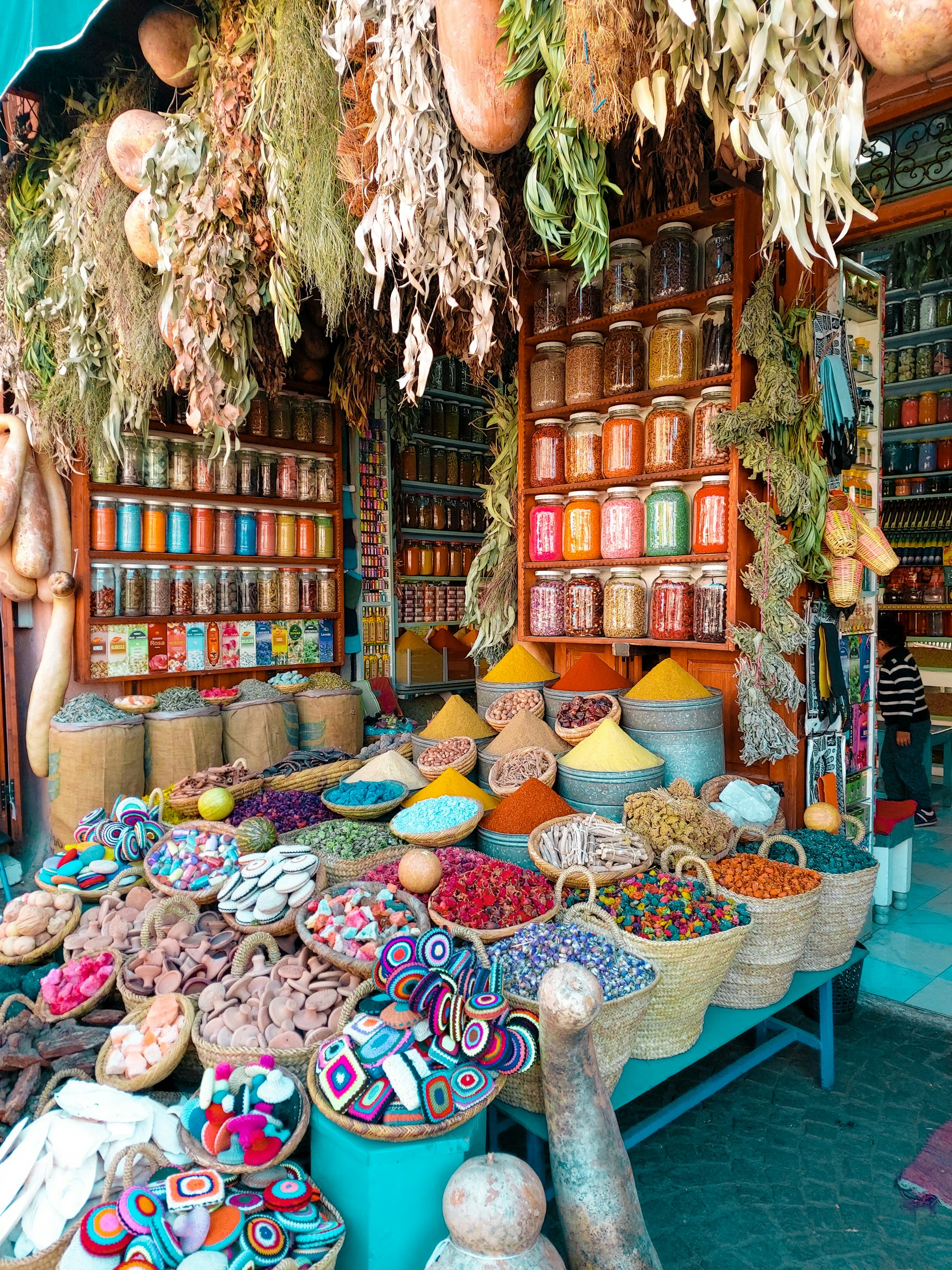
Beyond the headline buys, Morocco rewards the curious shopper. Berber silver jewellery — chunky, tribal, often set with amber or coral — carries real craft and history, though pure silver must be told from the nickel alloys sold alongside it; look for hallmarks and be wary of anything suspiciously light or suspiciously cheap. The spice stalls are a feast for the senses and the suitcase alike: true saffron from Taliouine, astonishingly good and far cheaper than in Europe; ras el hanout, the great house blend of a dozen or more spices, mixed in front of you; dried rosebuds from the Valley of Roses; and orange-blossom and rose waters distilled in the valleys and used in both cooking and cosmetics.
Then there are the pieces that cost little but carry the spirit of the place home: hand-chased brass and copper lanterns that throw patterned shadows across a room, woven palm and leather baskets that have quietly become a European summer staple, cedar boxes scented from the forests of the Middle Atlas, and the cosmetic trio of rhassoul clay, black soap and kohl that forms the heart of the Moroccan hammam ritual. Taken together, Morocco is, quite simply, a treasure chest — provided you know which drawers to open.
The Secret to Shopping Well: Buy With Someone Who Knows
Here is the honest truth about the Moroccan souk: it is thrilling, but it is designed to part the unwary from their money. Prices are fluid, quality is wildly variable, and the most beautiful workshops are rarely the ones you stumble upon by accident. The single best thing you can do is shop with someone who knows the real makers. A personal shopper in Marrakech turns the whole experience around: they take you to the genuine artisans rather than the resellers, read quality at a glance, negotiate in fluent darija on your behalf, and make sure what you carry home is authentic and fairly priced — and they can arrange shipping for the pieces too large for a suitcase.
Talking inlaid wood and mother-of-pearl with a trusted dealer — the right introductions open the finest workshops.
Shopping is also one of the great pleasures of travelling privately. On a private tour with a local guide, you can build in a morning at a women’s argan co-operative, an afternoon among the Fez tanneries, or a detour to a weaving village in the Atlas — not a rushed stop on a coach itinerary, but time to meet the makers, understand the craft, and choose well. In Morocco, the best souvenirs aren’t things. They’re the stories behind them — and the people who help you find them.
Inside a hand-chased brass lantern workshop — the kind of authentic find worth seeking out at the source.