





Most business owners pick a printing method the same way they pick a restaurant — they go with whatever is familiar and cross their fingers.
That works fine until a client wants 50 custom-printed tote bags, or a 20,000-piece direct mail run, and you realize the method you defaulted to is the wrong one entirely.
The cost difference can be brutal.
The U.S. printing and related support activities sector employs roughly 341,000 workers, according to the U.S. Bureau of Labor Statistics’ NAICS 323 industry profile — a number that tells you this is serious industrial infrastructure, not a boutique service. Offset lithography, screen printing, and digital printing all coexist in that workforce because each one solves a problem the others cannot. Choosing correctly means understanding exactly what separates them.
The Three Main Specialty Methods, Plainly Compared
Before getting into decision rules, it helps to have a clear map of the territory. Here’s how the three dominant methods stack up across the variables that actually matter to a business owner:
| Method | Best Run Size | Cost Per Unit (high volume) | Substrate Flexibility | Setup Complexity
|
|---|---|---|---|---|
| Offset Lithography | 1,000+ | Very Low | Paper, cardstock, some packaging | High (plate creation required) |
| Screen Printing | 24–500 | Low to moderate | Fabrics, plastics, metals, glass | Moderate (screen per color) |
| Digital Printing | 1–999 | Higher per unit, no setup fee | Paper, fabric, rigid substrates | Minimal |
There’s no universally “best” method on that table. There’s only the right fit for your job. That’s the entire decision.
Offset Lithography: The High-Volume Workhorse
Offset is the method that powers commercial print at scale. If you’ve ever held a glossy magazine or a beautifully printed catalog, offset is almost certainly what produced it. The process transfers ink from a plate to a rubber blanket and then onto the substrate — a process that delivers exceptional color consistency across massive runs.
The catch? Setup costs are real. Plates cost money, and the press needs time to reach color calibration. If your run is under 500 to 1,000 pieces, those setup costs spread across too few units and the math stops working in your favor. But for a 10,000-piece brochure campaign, offset becomes dramatically cheaper per unit than any alternative.
Offset is the right call when: you need volume, consistent color reproduction (especially for brand-matched Pantone shades), and you’re printing on paper or light cardboard. It is not the right call when a client needs 75 printed mugs.
Screen Printing: Built for Substrates That Aren’t Paper
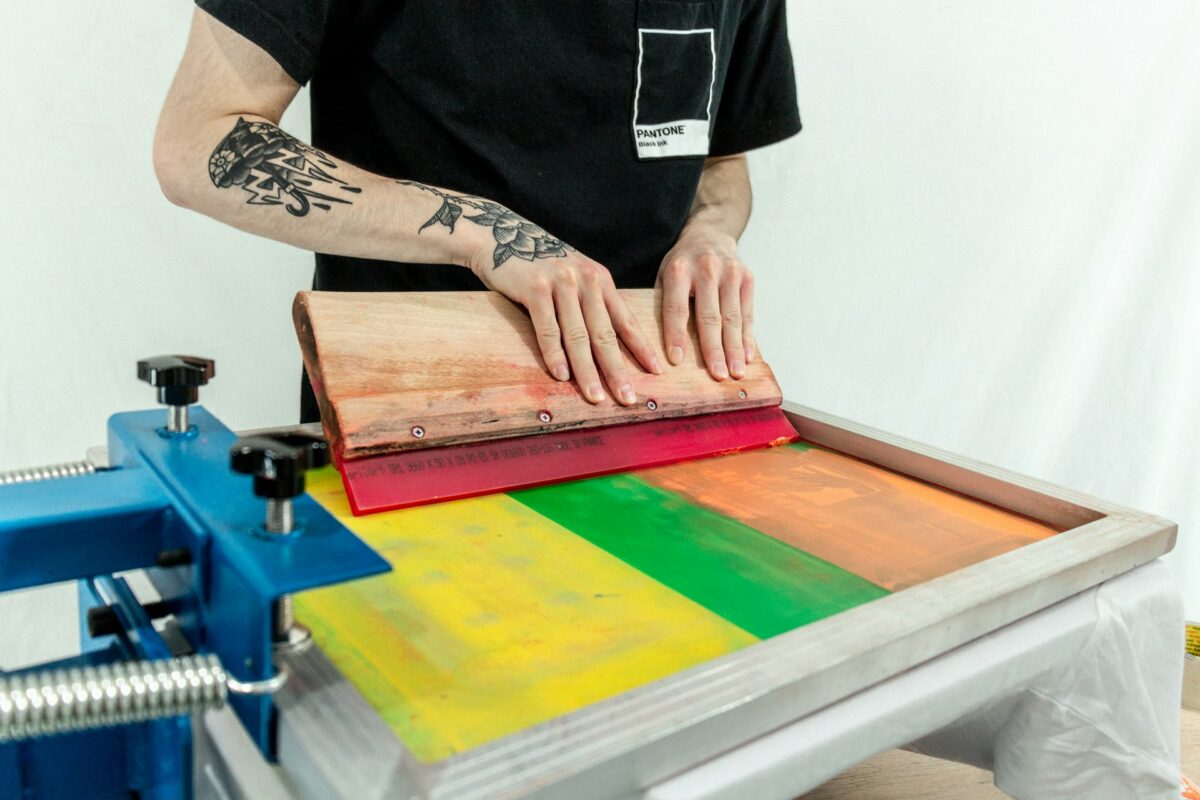
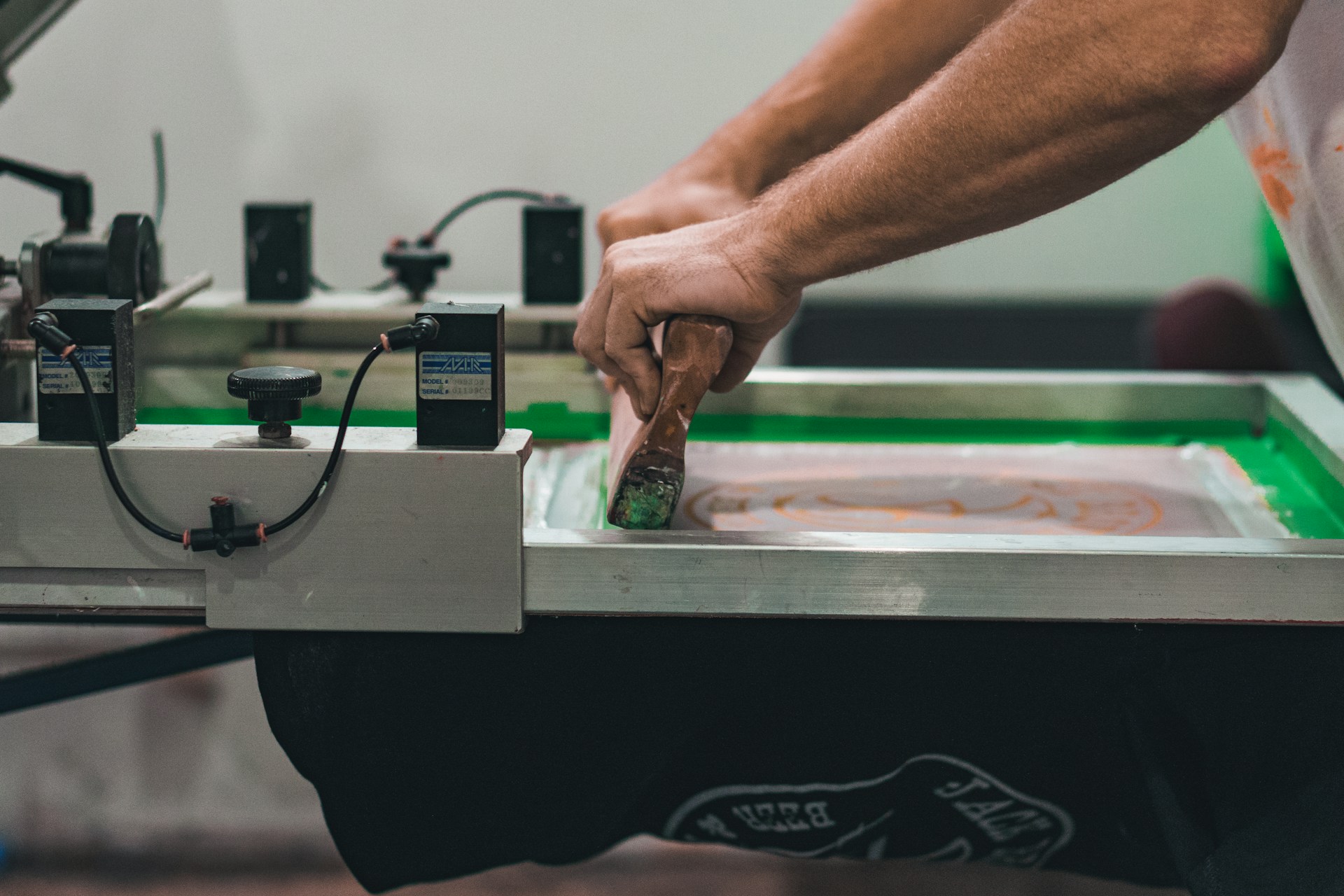
Screen printing forces ink through a mesh stencil directly onto the substrate. That sounds simple, and it is — but the simplicity is what makes it so powerful for non-paper surfaces. T-shirts, hoodies, vinyl banners, glass bottles, plastic panels: screen printing covers all of it with ink opacity that digital processes genuinely struggle to match on dark or textured surfaces.
Each color in the design requires its own screen, which means a four-color design involves four setups. That’s why screen printing rewards mid-range order quantities, roughly 24 to 500 pieces, where setup cost per unit is reasonable. Complex gradients are difficult, but bold, solid graphic work looks exceptional.
A shop in Phoenix I’d call Maria’s Print Co. (a composite of dozens of real shops making this exact decision) faced this situation with a brewery client wanting 200 printed tap handles. Digital printing gave muddy results on the curved plastic. Offset was out of the question. Screen printing hit the color saturation the client needed, and the per-unit cost came in under $4. That’s the kind of fit that screen printing enables when the alternatives don’t.
Digital Printing: Where Speed and Personalization Win
Digital is the youngest of the three methods and the fastest growing. It skips plates and screens entirely, printing directly from a digital file. That means zero setup cost, near-instant turnaround, and the ability to change the artwork on every single piece — variable data printing, in industry terms.
The U.S. commercial printing market was estimated at $129.21 billion in 2025 and is projected to reach $169.49 billion by 2033, according to Grand View Research , and a significant portion of that growth is being driven by short-run and on-demand digital production. The surge in print-on-demand services has had a positive influence on the commercial printing sector, and by printing technology, the lithography segment still led the market with the largest revenue share of 44.9% in 2025 — but digital is the one closing the gap fastest. That trajectory reflects a real shift in buyer behavior: clients want smaller quantities, faster, with personalized content.
Digital is your best option when the order is under 500 pieces, when each piece needs unique information (names, QR codes, addresses), or when turnaround time is the client’s overriding concern. The per-unit cost stays higher than offset, and color on dark substrates can be less saturated than screen — but neither of those trade-offs matters when a client needs 50 personalized event programs by Thursday.
The Print Method Fit Framework
Run through this four-question sequence before committing to a method on any job. It takes two minutes and catches most expensive mismatches before they happen.
- What is the substrate? Non-paper materials (fabric, glass, metal, plastic) point immediately toward screen printing. Paper or cardstock opens the full field.
- What is the quantity? Under 500 units means digital unless the substrate rules it out. Over 1,000 means offset if the design allows. Between 24 and 500 on a non-paper surface means screen.
- Does the artwork change piece to piece? Yes means digital, no exceptions.
- What is the color requirement? Exact Pantone matches on paper at volume means offset. Bold, opaque color on dark fabric means screen. Photographic detail on short runs means digital.
That framework won’t cover every edge case, but it eliminates the obvious mismatches. The edge cases are usually where you call a specialist.
Getting Your Supplies Right for Each Method
Method selection is only half the decision. Each process runs on its own category of consumables, and sourcing those correctly affects both quality and margin. Offset shops need inks formulated for litho presses, blankets, plates, and fountain solutions. Screen operations need mesh screens, emulsion, squeegees, and plastisol or water-based inks. Digital workflows depend on OEM or compatible toner and inkjet cartridges, along with compatible media.
Working with a reliable printing supplies distributor that carries across all three categories means you’re not hunting between three separate vendors every time a job changes methods. That kind of one-stop sourcing keeps your procurement lean and your lead times predictable, which matters when a client’s deadline is the only thing they actually care about.
“The shops that survive long-term are the ones that understand their equipment deeply and source their consumables consistently. Random substitutions in inks or substrates are where quality problems start.” — A sentiment widely held across print production communities and benchmarking surveys published by print trade associations.
One More Thing About Hybrid Shops
Many successful shops don’t pick one method. They build around two — typically digital for short-run flexibility and either offset or screen depending on their core client base — and subcontract the third. That’s a reasonable posture. Trying to run all three in-house with full competency requires capital, floor space, and skilled labor that most shops can’t justify early on.
Pick the method your best clients need most. Build depth there first. Add a second capability when the revenue supports it. The shops that spread themselves across every process before they’ve mastered one tend to do all of them adequately and none of them exceptionally well.
So which method fits your current client mix? Answer that honestly, and the equipment and supply decisions that follow become a lot less complicated.