

Ask any working jeweller what people are actually asking for and a version of the same answer comes back.
Geometry.
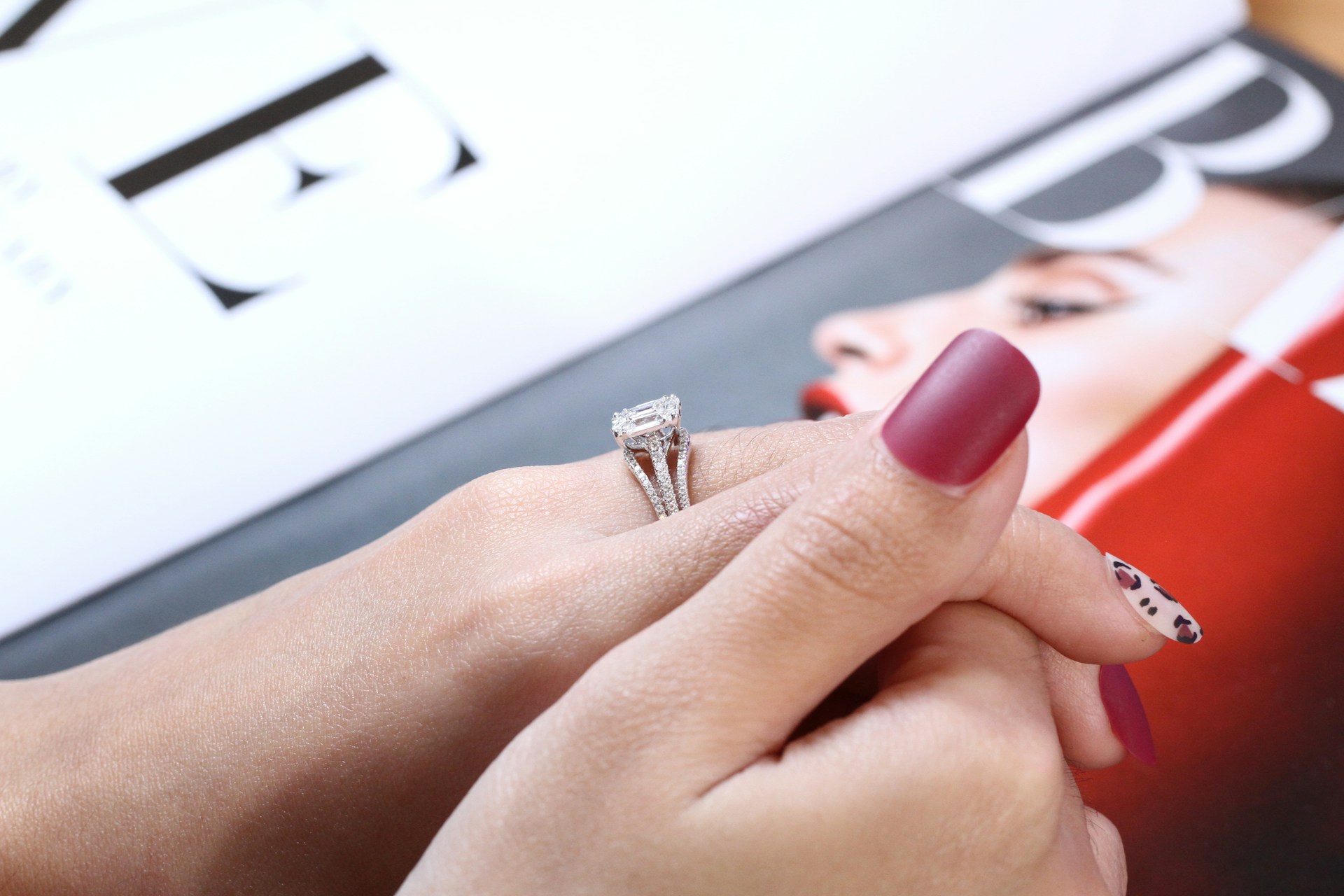
Millegrain. Baguettes. Something that looks like it came out of the 1920s.
Art Deco has been revived before, but the current run is unusually sustained, and it is worth understanding why a design language from a hundred years ago suits contemporary buyers so well.
What Art Deco actually was
The name comes from the Exposition Internationale des Arts Decoratifs held in Paris in 1925, and the movement it describes ran roughly from the end of the First World War to the Second.
Its central move was from organic to geometric. The Edwardian jewellery it replaced was all curves: garlands, bows, ribbons, laurel wreaths rendered in platinum lacework so fine the metal nearly vanishes. Deco squared everything off. Straight lines, repeated forms, hard symmetry and deliberate contrast.
It looked like the architecture going up at the same moment, which was entirely the point. The Chrysler Building and a 1928 engagement ring are doing the same thing at different scales.
The technical vocabulary
Several specific techniques define the look, and knowing their names makes shopping for it considerably easier.
Step cuts. Emerald and Asscher cuts use long parallel facets arranged in steps rather than the triangular facets of a brilliant. The result is broad flashes of light, described in the trade as a hall of mirrors, rather than rapid scintillation. They suit a geometric aesthetic because they are geometric.
Baguettes. Small rectangular step-cut stones used as structural lines, flanking a centre stone or running as a band. They are the closest thing jewellery has to architectural moulding.
Calibre cutting. Coloured stones, typically sapphire, ruby or onyx, cut to precise custom shapes so they fit a channel with no gaps. Enormously labour intensive and the single clearest marker of a serious Deco piece. Blocks of hard colour against white metal and white diamonds.
Millegrain. A row of tiny beads worked into a metal edge with a knurled wheel. It softens an edge visually and catches light along a line. Almost every genuine Deco piece has it somewhere.
Filigree and pierce work. Openwork panels, often in the gallery beneath the stone, so the ring reads as light rather than solid even where there is a lot of metal.
Platinum. The enabling technology. Strong enough to hold stones with very little metal, and naturally white, which flattered diamonds in a way silver never managed without tarnishing.
Why it suits now
Several reasons, and only one of them is fashion.
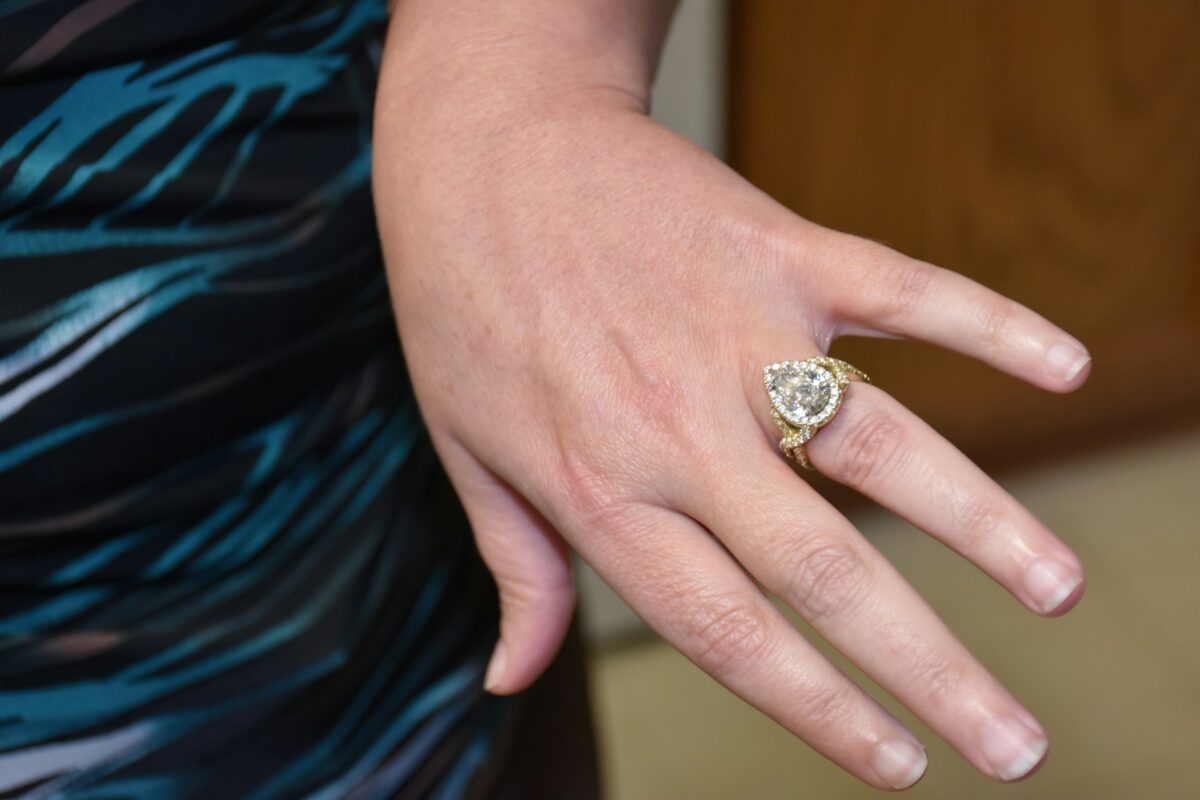
It photographs well from above. The flat, symmetrical, high-contrast top surface of a Deco ring is exactly what a phone camera pointed straight down handles best. A tall claw-set solitaire is harder to capture. This is a genuine driver rather than a cynical observation.
It reads as distinctive without being unusual. Buyers increasingly want something nobody else has, while not wanting anything strange. Deco solves this neatly: recognisably historical, visibly not the standard solitaire, and not weird.
It wears well. Deco rings tend to sit low, which means they catch on less and take fewer knocks than the raised settings that dominated the 2000s. For anyone who works with their hands, this is a practical advantage rather than an aesthetic one.
And the economics have shifted in its favour, which is the part almost nobody discusses.
The reason behind the current revival
Two market changes in the last eighteen months have quietly pushed design in this direction.
Laboratory-grown diamond prices have collapsed. Manufacturing capacity expanded enormously, average prices fell 20 to 30 per cent against 2024 alone, and some categories are down more than 90 per cent from their peak. Above a carat, lab-grown now commonly sells at 5 to 10 per cent of a natural equivalent.
In late 2025 the Gemological Institute of America stopped applying its D to Z colour scale and flawless to included clarity scale to laboratory-grown diamonds, replacing them with two descriptive categories, premium and standard.
Here is the design consequence. When the centre stone costs a fraction of what it used to, the budget moves into the setting. Deco is a labour-intensive style, all millegrain and pierce work and calibre-cut accents, and it was priced out of the mainstream for decades precisely because that labour was expensive relative to the stone.
That ratio has inverted. Buyers who would once have put ninety per cent of a budget into a centre stone can now put a meaningful share into bench work, and elaborate settings have become affordable for the first time in two generations.
The revival is not only nostalgia. It is a rational response to a change in relative prices, which is exactly what produced the original Deco boom in the 1920s when platinum made fine work newly possible.
Genuine antique versus made today
Both are legitimate and they are different products.
A genuine period piece, made between roughly 1920 and 1935, has a character reproductions struggle to match, mostly because of the stones. Diamonds of the period are old European and old mine cuts, cut by hand before electrical precision, with small tables, high crowns and open culets. They produce slow broad flashes and noticeably more fire than a modern brilliant, because they were cut for candlelight and gaslight rather than for LED.
The drawbacks are real. Antique settings have had a century of wear, claws and shanks may be thin, and metal fatigue is common. Sizing can be difficult or impossible depending on the design. And condition varies enormously.
A newly made Deco-style ring gives you modern construction, exact sizing, a stone with a current independent certificate, and a setting engineered for a modern lifestyle. It will not have the optical character of a century-old stone unless you deliberately source one.
There is a third option that frequently produces the best result: a new setting made in period style around an antique stone, or around a family stone. This is among the most common commissions a studio receives, and it solves both problems at once.
Buying it well
Ask whether the millegrain is worked or cast. Genuine millegrain is applied to the finished metal with a wheel by hand. Cast millegrain, where the texture is part of the mould, is softer, less crisp and much cheaper. It is the fastest way to judge how serious a piece is.
Look at whether the geometry is actually symmetrical. Deco lives or dies on precision. Baguettes that do not align, or a halo that is fractionally off-centre, ruins a design whose entire logic is order.
Ask about the calibre stones if there are any. Properly calibre-cut accents fit their channel with no visible gap. Approximately-sized stones with fill around them are a different product.
Check the profile from the side. A well-made piece in this style is interesting from every angle, with pierce work and detailing in the gallery. Cheap versions are decorated on top and blank underneath.
Understand the cut grade on the centre stone. If you have chosen a step cut, emerald or Asscher, be aware they are less forgiving of inclusions than brilliants, because you are looking straight into the stone through flat parallel facets rather than through a scattering prism. Eye-clean matters more here.
And if you are using an antique stone, have it independently assessed. Old cuts do not grade the same way modern ones do and the paperwork, where it exists, may be decades old.
The shapes that carry the style
If you want the aesthetic without a fully worked period piece, the centre stone shape does most of the job on its own.
Emerald cut. The signature Deco shape. Long, rectangular, step faceted, with cut corners. It elongates the finger and it is unapologetically architectural. Because you see straight into the stone, clarity and colour show more than they would in a brilliant, so buy eye-clean and do not chase a paper grade.
Asscher. Essentially a square emerald cut with more dramatic cut corners and a deeper pavilion, producing a distinctive concentric pattern. Patented in 1902 and definitively of the period.
Old European. Round, hand cut, with a small table and an open culet. The most authentic choice and the most variable, since no two are identical.
Baguette. Rarely a centre stone, almost always the flanking pair, and the single cheapest way to move a plain solitaire toward the style.
Elongated cushion. Softer than an emerald cut and more forgiving, sitting between Deco geometry and something more contemporary.
Avoid, if authenticity matters: princess cuts, which are a 1980s invention, and anything with a modern halo of tiny pave stones, which reads 2005 rather than 1925.
Metals and what they do to the look
Deco is a white metal aesthetic and the reason is optical. White metal disappears against diamonds, so the geometry reads as pure pattern rather than as metalwork holding stones.
Platinum is the historically correct answer, and the practical one. It is strong enough to support fine pierced work, naturally white so it never needs replating, and when it scratches it displaces rather than wears away.
Eighteen carat white gold is the common alternative. It is yellow gold alloyed and then rhodium plated, and that plating wears through over a few years to reveal a warmer tone beneath. Replating is inexpensive and routine, but on a piece with deep pierce work and millegrain it is fiddlier than on a plain band, because the plating has to reach into every recess.
Yellow and rose gold Deco exists, particularly from the tail of the period as platinum became restricted, but it changes the character substantially. The contrast that makes the style work is reduced.
Where the work actually happens
Art Deco is a style that exposes the maker. A solitaire can be assembled competently from components. A ring with hand-worked millegrain, pierced galleries, calibre-set accents and aligned baguettes cannot, because every one of those is bench work performed on the specific piece.
That is why most of what is sold as Deco-influenced in chain retail is a simplified approximation, and why the style has driven so many buyers toward studios that make rather than retail. Workshops producing art deco engagement rings to order, Stelios Jewellers among the Australian ones, tend to be the places holding the specific skills, because the techniques only survive where someone is practising them regularly.
Ask where a ring was physically made and whether repairs and setting happen on site. A business without a bench cannot produce this work, whatever the marketing says.
The Australian angle
One period detail with a local connection. Deco made heavy use of strong colour against white metal, and Australian sapphires, particularly the parti sapphires from Queensland with their zones of blue, green and gold, suit the aesthetic remarkably well while looking nothing like the standard Ceylon blue.
Separately, the Argyle mine in Western Australia produced over 90 per cent of the world’s pink diamonds until closing permanently in November 2020, with Rio Tinto’s final tender concluding in October 2025. Pink accents in a Deco setting are an unmistakably Australian interpretation of the style, and the provenance paperwork now matters considerably, since supply is fixed and Argyle origin carries a 20 to 50 per cent premium over comparable pinks.
Living with one
A few practical notes, because this style has particular maintenance characteristics.
Millegrain wears. Those tiny beads along an edge are the highest point on the ring and they soften over decades of contact. A good jeweller can rework them, and it is worth doing before they disappear entirely rather than after.
Pierced galleries collect. Openwork beneath a stone traps hand cream, soap and general residue, and a Deco ring that looks dull is almost always a Deco ring that needs cleaning rather than one with a poor stone. Warm water, a drop of dishwashing liquid and a soft toothbrush, paying attention to the underside.
Calibre-set stones need checking. They are held by precise channel walls rather than claws, and a knock that deforms the channel can loosen several stones at once.
Antique shanks thin. On a genuine period piece, the band is the part that has been rubbing against a finger for a century. Reshanking is routine, sympathetic and does not affect the piece’s integrity.
Have any ring in this style checked annually. The work is inexpensive at a routine inspection and expensive once something has been lost.
The short version
Deco is having a long moment because it photographs beautifully, wears comfortably, reads as individual without being strange, and has become affordable at exactly the moment cheap centre stones freed up budget for bench work.
Buy it from someone with a workshop. Check the millegrain, check the symmetry, check the gallery. And if you can find a stone cut before 1930, look at it under a warm light before you decide anything, because that is the part no reproduction gets right.