

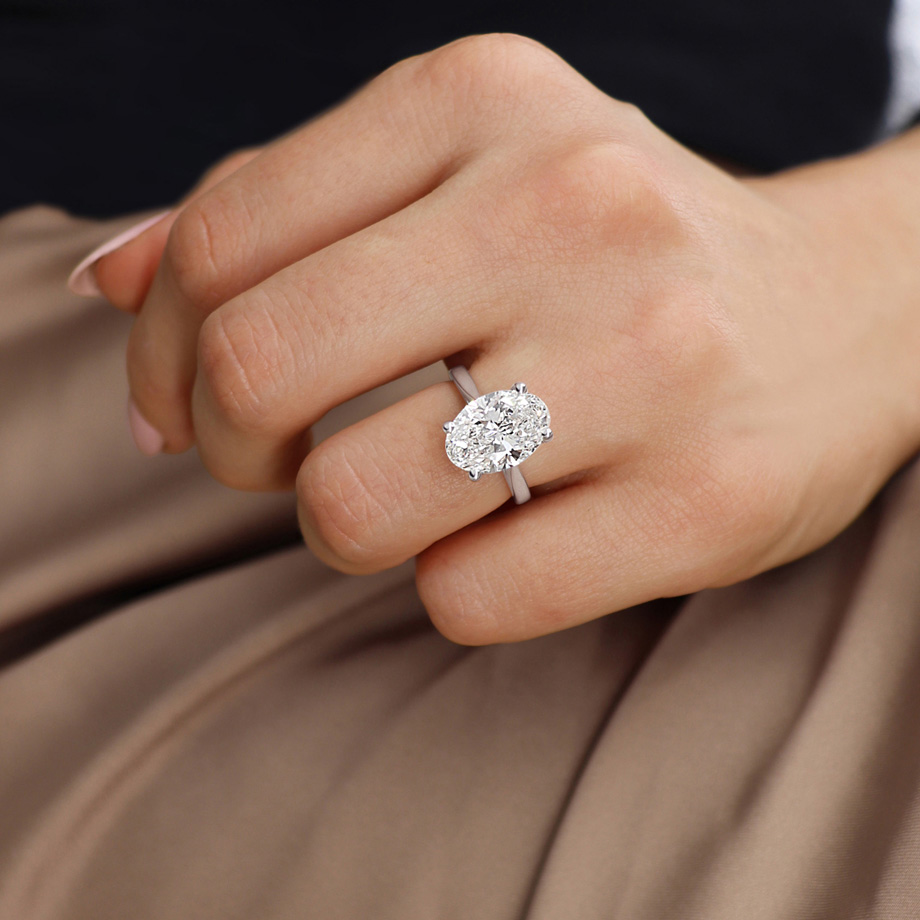
You like a diamond with some length and rounded edges.
An oval feels right, until an elongated cushion catches your attention.
Put the two side by side and the difference can seem surprisingly small, especially when each sits in a different setting.
The clearest distinction is the outline: an oval has a continuous curve, while an elongated cushion has a pillow-like rectangular shape with rounded corners. Those softened corners can give a cushion a little more structure, even when both diamonds have similarly long proportions.
Start with the outline: curves or rounded corners?
As GIA’s cushion-cut guide explains, cushion diamonds vary considerably in both outline and facet arrangement. Some look squarer, while others stretch into a longer rectangle.
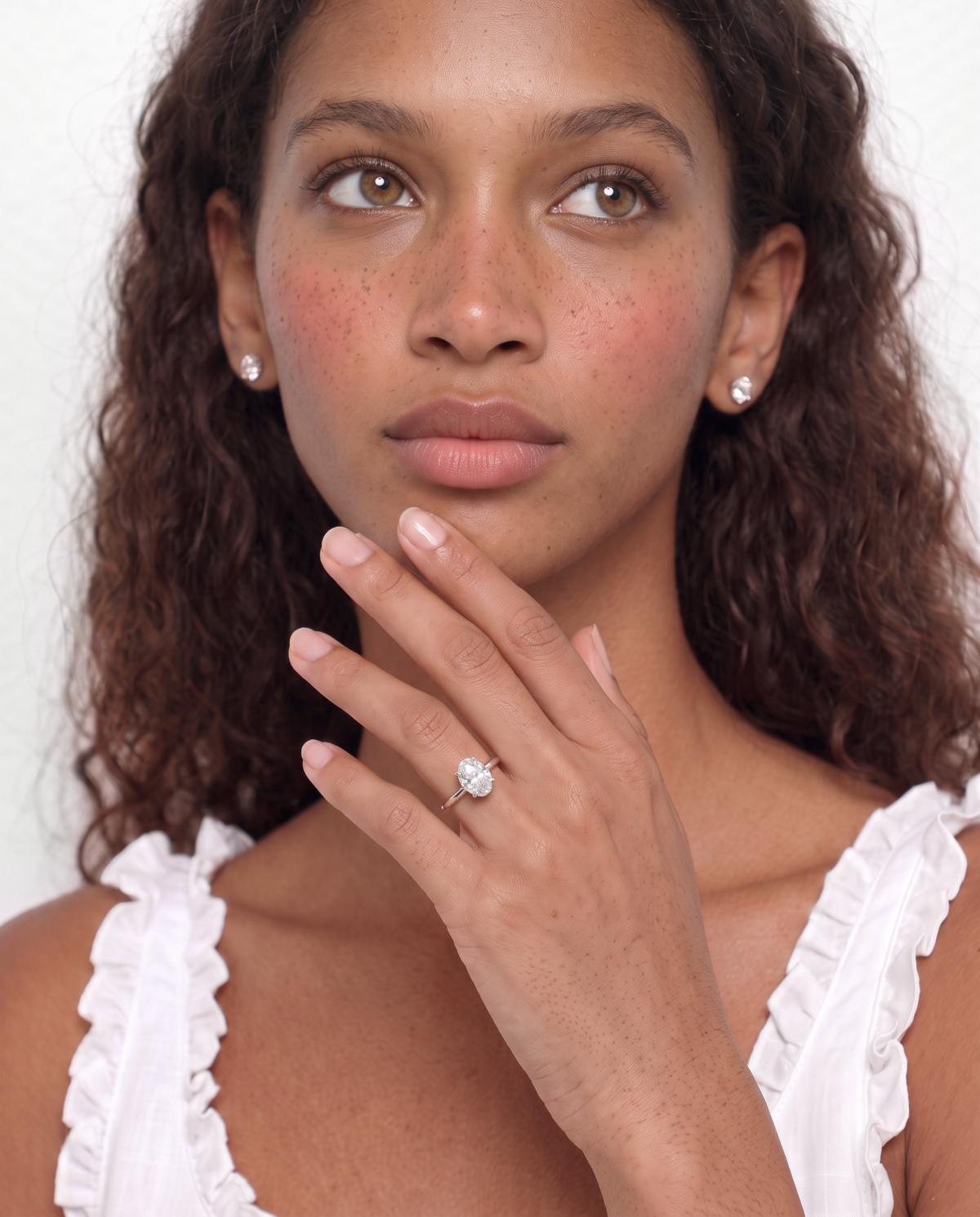
For a direct comparison, look at an oval diamond ring such as Lily Arkwright’s Lulu alongside the elongated-cushion version in the same platinum setting. Both list 1.65mm bands. Compare stones with similar length and width measurements too, so the setting and scale do not distract from the outline.
Look at photographs taken directly above the stone. A tilted photograph can make either shape appear shorter or narrower. Follow the outside edge with your eye: do you enjoy the oval’s uninterrupted curve, or the cushion’s gentle suggestion of a rectangle?
Compare Dimensions, Not Just Carat Weight
Neither shape name tells you how large a particular diamond will look. Carat measures weight, and some of that weight sits below the visible top of the stone. Ask for the length and width in millimetres when comparing individual diamonds.
Divide the stone’s length by its width to find its length-to-width ratio. A higher number means a more elongated outline, although an oval and a cushion with the same ratio will still have different curves and corners.
Illustration: both outlines use example dimensions of 9 × 6mm, a ratio of 1.50. This compares shape only, not carat weight, sparkle or specific products.
To compare the look, ask to see stones with similar visible dimensions. To compare what your budget buys, ask for options within the same price range and keep the other specifications as consistent as possible. This separates the shape you like from the size available within your budget.
Avoid drawing a size conclusion from separately enlarged product images. Ask which stone dimensions are shown in each photograph, especially if the same image illustrates several carat options.
Does an oval or an elongated cushion sparkle more?
Shape outline and sparkle pattern are separate decisions. Facets, the polished surfaces cut into a diamond, create its pattern of reflections. An elongated cushion can show distinct flashes or a finer “crushed ice” effect; ovals also vary.
GIA’s guide to diamond shapes and cut styles explains the distinction. Compare the actual diamonds moving slowly under the same lighting, then in softer light away from display spotlights.
An oval may show a darker bow-tie-shaped area across its centre. Watch whether it stays conspicuously dark through a gentle tilt rather than judging one photograph. GIA’s research on fancy-shaped diamonds explores how these patterns change with viewing position.
Compare settings without losing the shape
A plain solitaire makes the central outline easy to notice. A bezel, which surrounds the stone with a rim of metal, adds a visible frame. A halo of smaller diamonds introduces another outline around it. Try the same general setting style in both shapes before deciding that one diamond is more your style.
Keep the metal, band width and stone dimensions as similar as possible. Otherwise, you may be responding to a different colour or a heavier band rather than the diamond’s outline.
Neither outline dictates the ring’s entire personality. An elongated cushion does not have to look antique, and an oval does not have to sit on a fine, minimal band. The setting can make either feel spare, decorative or bold.
Choose the shape that works with your jewellery
Use a familiar accessory as a reference. An oval might echo the curves of your favourite hoops; an elongated cushion might pick up the softened corners of a rectangular watch. Swap the pairings too: sometimes the contrast is what makes the combination interesting. If you are choosing for someone else, start with the jewellery they already wear when matching a ring to your partner’s style.
When coordinating an engagement ring and wedding band, include both in the fitting. The fit depends on the setting’s construction, so the diamond’s outline alone cannot tell you whether a straight band will sit closely alongside it.
By this point, the deciding detail may be quite small: the sweep of the oval’s end, the cushion’s rounded corner or the way a particular diamond flashes as you move. Being able to recognise that detail is a better reason to choose a ring than a blanket verdict that one shape is best.