





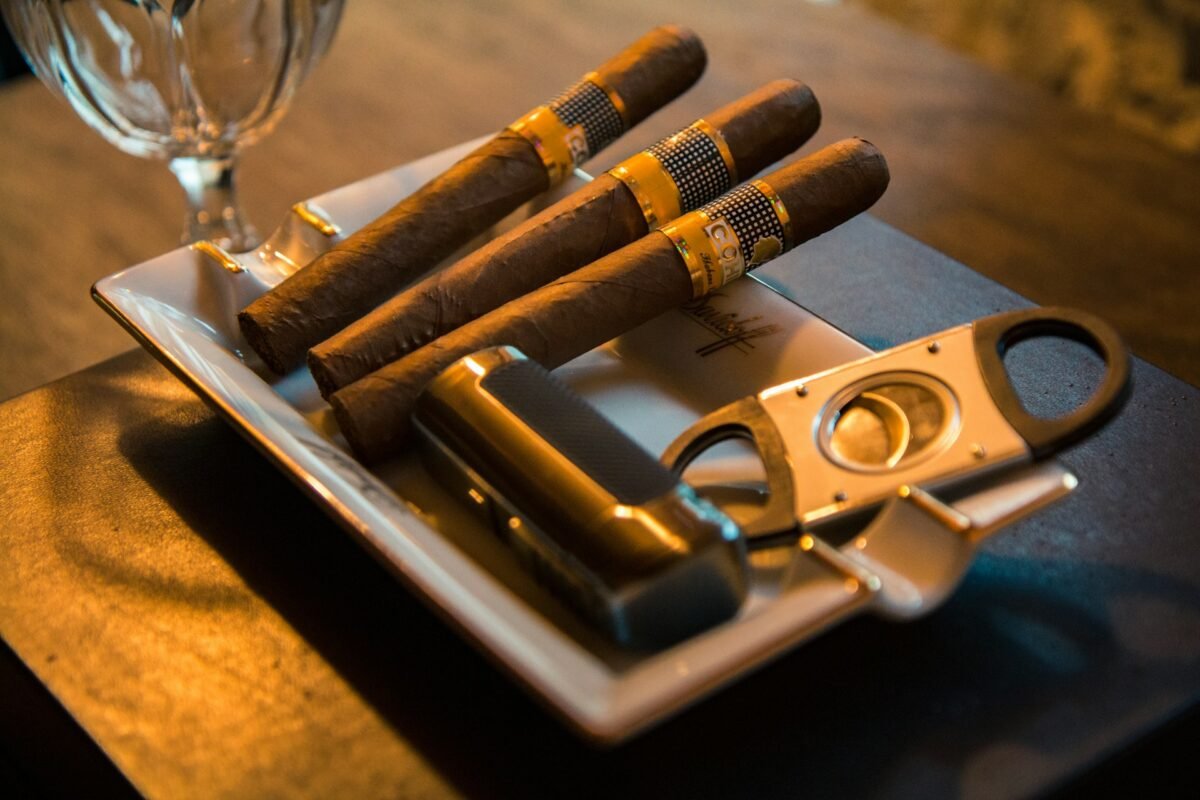

The cigar exists at an interesting cultural intersection right now. It carries genuine historical weight, a century-plus of tradition across Cuba, the Dominican Republic, Honduras, and Nicaragua, while simultaneously attracting a younger, more aesthetically literate audience that approaches it the way they approach single-origin coffee or natural wine: with curiosity, some skepticism, and a growing investment in doing it properly.
The craft cigar market has grown considerably over the past decade, with premium hand-rolled sales in the United States rising steadily through the early 2020s even as the broader tobacco category contracted. People are buying fewer cigars and spending more on the ones they buy. That calculus only makes sense if the cigars are being stored correctly.
Most of them aren’t.
Storage is the quiet variable that determines whether a $30 cigar tastes like it’s supposed to or tastes like something adjacent to what it was meant to be. The leaf is a living thing even after it’s been harvested, fermented, and rolled. It responds to its environment continuously, expanding and contracting as humidity fluctuates, exchanging moisture with the surrounding air in a slow but constant process that either preserves its character or gradually strips it away. The difference between a cigar stored at 68% relative humidity and one stored at 52% is not subtle. It’s the difference between a complex, even burn with the flavor profile the blender intended and something dry, harsh, and structurally compromised.
What Actually Happens to a Cigar in Suboptimal Conditions
Tobacco leaf is hygroscopic, meaning it naturally absorbs and releases moisture depending on the relative humidity of its environment. At the microscopic level, the cell walls of cured tobacco contain hygroscopic compounds, primarily sugars and organic acids, that bind to water molecules when ambient humidity is high and release them when it drops. This makes the leaf a kind of passive humidity sensor, always trending toward equilibrium with its surroundings.
The problem is that rapid or repeated moisture changes cause the wrapper, binder, and filler leaves to expand and contract at different rates. Wrapper leaf, which is the outermost layer and typically the most expensive component of a premium cigar, is rolled under tension and is particularly sensitive to humidity swings. When it loses moisture too quickly it becomes brittle, develops hairline cracks, and eventually splits. When it absorbs too much moisture the draw tightens, the burn becomes uneven, and the oils responsible for the cigar’s aromatic complexity migrate toward the surface rather than releasing gradually during combustion.
A properly humidified cigar burns evenly, produces a consistent ash, and delivers its flavor in recognizable stages: a first third that opens with the blend’s initial notes, a middle third where the profile develops and deepens, and a final third that intensifies as the oils concentrate. None of that progression happens when the leaf has been compromised by improper storage. You get heat, harshness, inconsistency, and something that tastes like a rough approximation of what you paid for.
The Traditional Humidor and Its Limitations
The Spanish cedar humidor is the canonical storage solution, and it works reasonably well under stable conditions. Cedar is the preferred interior wood because it has a natural affinity for tobacco oils, imparts a complementary aromatic character, and absorbs and releases moisture in a way that moderates humidity fluctuations. A well-seasoned cedar humidor with a properly calibrated hygrometer and a quality humidification device will maintain adequate conditions indefinitely, assuming you stay on top of it.
That last clause is where most humidors fail in practice. Traditional humidification devices, whether foam-based, gel crystal, or Florentine floral foam, release moisture in one direction only. They add humidity to a dry environment, but they cannot absorb excess moisture when conditions are already too damp. If you live in a humid climate, open your humidor frequently, or simply forget to monitor the hygrometer for a few weeks, moisture levels can climb well above the target range. Mold becomes a real possibility at 75% RH and above. The cigars at the bottom of a full humidor, pressed against each other, are often sitting at meaningfully different humidity levels than those near the humidification device at the top.
The goal of cigar storage isn’t to add humidity. It’s to maintain equilibrium. Those are different problems with different solutions.
Two-way humidity control changes the storage equation by replacing passive humidification with active regulation. Boveda humidifier packs use a saturated salt solution sealed in a semipermeable membrane to both absorb and release moisture as needed, maintaining a precise target RH within a sealed environment. The chemistry is specific: different salt solutions produce different equilibrium humidity levels, which is why the packs are available at 58%, 62%, 65%, 69%, 72%, and 75% RH. The intended storage range for most premium cigars falls between 65% and 72%, with personal preference and regional climate playing a role in where within that range individual collectors tend to land.
Choosing the Right Humidity Level for Cigars
The standard advice of “keep your cigars at 70% humidity and 70 degrees Fahrenheit” has been repeated so many times it has acquired the authority of fact. The reality is more nuanced. The 70/70 rule is a reasonable approximation for general storage, but it was developed as a practical guideline for retail environments, not a scientifically optimized target for every cigar in every condition.
Cigars from different regions and with different wrapper varietals have distinct moisture characteristics. A Cameroon wrapper, known for its fine grain and oil content, can become susceptible to surface mold at the higher end of the traditional range and often fares better around 65% to 67%. Connecticut broadleaf maduro wrappers, which are thicker and more oil-dense, can tolerate and in some cases benefit from slightly higher humidity. Nicaraguan puros, made entirely from Nicaraguan tobacco across all components, tend to be rolled tighter than Dominican blends and often smoke better when stored a touch drier, around 65%, to keep the draw from constricting.
None of this complexity is particularly difficult to manage once you understand it. It does, however, expose the limitation of a one-size-fits-all approach to humidification. A collector with multiple regional blends in the same humidor is essentially making a compromise for all of them. Separate storage by wrapper type or origin, each regulated to its own optimal RH, is the approach taken by serious collectors and most well-run cigar lounges.
What Seasoned Collectors Know About Long-Term Aging
The cigar aging conversation has its own devoted subculture, people who buy boxes with no intention of smoking them for three to five years, watching as the various tobaccos marry, the fermentation process continues slowly, and the flavor profile develops in ways that weren’t present at rolling. Aging is real and well-documented. It is also entirely dependent on storage conditions being stable over the full duration of the aging period.
A cigar stored at fluctuating humidity doesn’t age gracefully. The moisture cycling that degrades it over weeks does cumulative damage over years. What you open after five years of improper storage is not a well-aged cigar. It’s a compromised one that happens to be old. The appeal of aging is that time plus stable conditions produces chemical transformations in the tobacco: ammonia from the fermentation process dissipates further, oils redistribute, harsh edges in the flavor profile soften. Unstable humidity doesn’t allow those processes to proceed evenly. You get pockets of over-dried leaf, uneven oil distribution, and an inconsistent smoke.
For anyone aging cigars seriously, consistent RH regulation over the full aging window is not optional infrastructure. It is the whole point.
The Practical Setup
Getting cigar storage right doesn’t require significant expenditure or elaborate equipment. The core requirements are a well-sealed container, an accurate digital hygrometer, and a reliable humidity regulation method. The container can be a traditional cedar humidor, a tupperdor (an airtight plastic container lined with cedar sheets, preferred by many collectors for its superior seal), or a wineador (a wine refrigerator repurposed for cigar storage, which adds temperature control for larger collections in warm climates).
Whatever the container, the humidity regulation approach determines the stability of conditions inside it. Passive devices require monitoring and periodic refilling. Two-way regulation packs require only replacement when they harden throughout, signaling that the salt solution has been fully spent. For a collector who doesn’t want to spend significant time maintaining their setup, the difference in practical convenience is substantial. For one managing multiple humidors or aging cigars over years, stable passive regulation removes a variable that doesn’t need to exist.
The cigar itself does everything else. The blender chose the tobaccos, the roller built the construction, the fermentation and curing process developed the base character. What storage provides is the conditions under which all of that craft either survives to the moment of lighting or quietly erodes in the dark. It is, by that measure, probably the least glamorous and most consequential part of the experience.