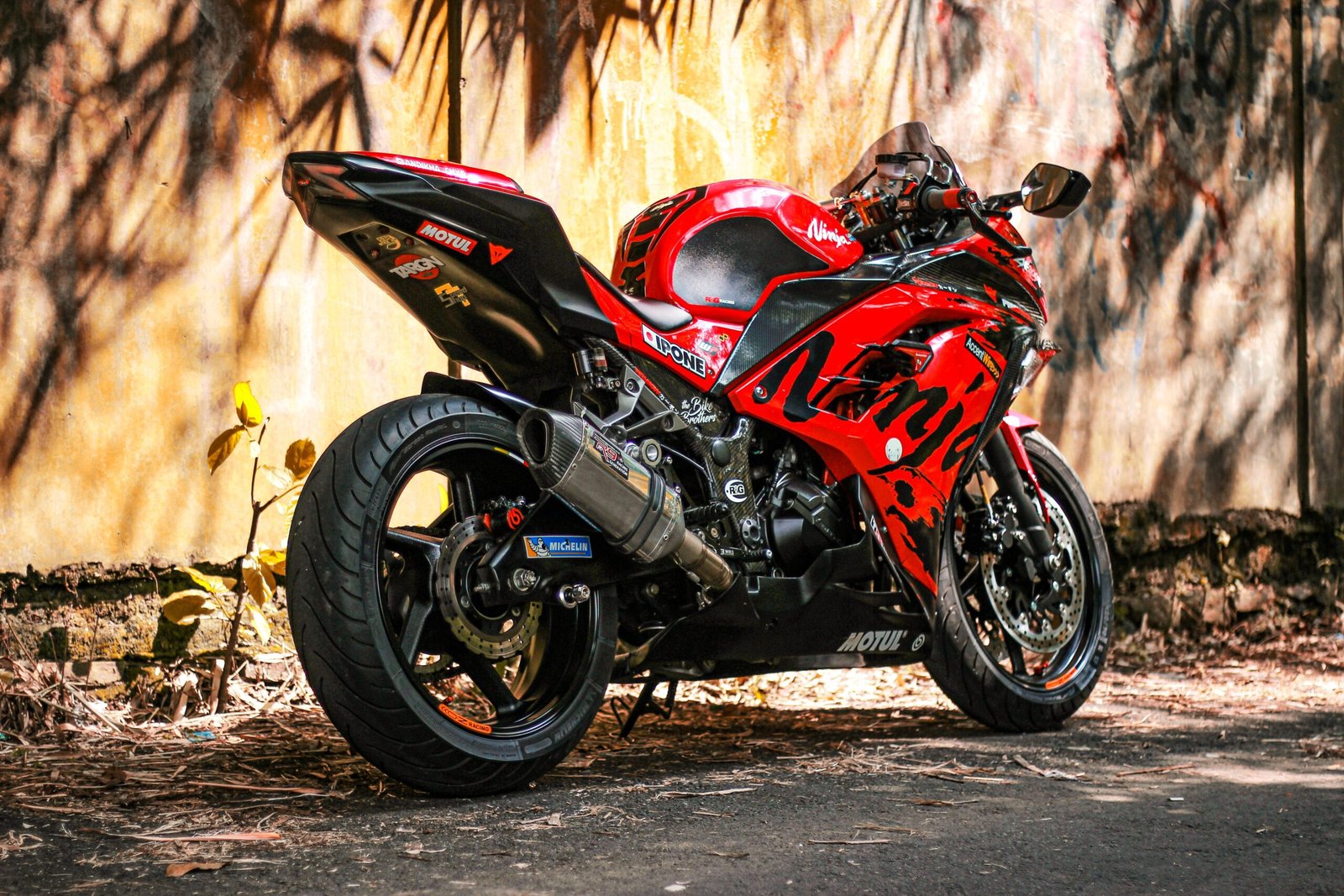





There are many ways to customise a motorcycle, and more particularly motorcycle paint. This is a discipline related to tuning, more precisely called custom paint.
Some automotive painters have retrained and specialised in motorcycle paintwork. Fortunately, in this field there is no restrictive legislation regarding the design and colours that can be freely displayed on a motorcycle’s fairings. In the field of custom paint, here are different styles for applying motorcycle paint:


- First of all, effect paints
- Graphic designs such as “racing”
- Designs with airbrush paints suitable for motorcycles
- Hydrographic transfer printing
The particularities of motorcycle paints
The technique of painting on a motorcycle is exactly the same as that for car bodywork, with some slight differences due to the flexibility and type of materials. This may require specific preparation of plastic parts and the use of special additives to increase the flexibility of 2K finishes. The main tool for applying the paints is the spray gun, which is used for primers, paints, and finally clearcoats.
The different parts making up the tank, mudguards, and fairings are generally made of steel or ABS-type plastic, more rarely PP or PE.
Surface preparation
In all cases, a single type of primer is used as the base coat, meaning the foundation of the paintwork. This primer levels and perfects the surface, while also providing adhesion and protecting metal parts against corrosion. For bare plastics, manufacturers use special flame treatments and primers specifically for plastic. For those wishing to customise the paintwork of their motorcycle’s plastic fairings, these parts are already painted and primed. Therefore, it will be necessary to use a primer both to cover the unevenness caused by stickers or various paint layers, and to create a uniform background colour. Indeed, when painting pearlescent or metallic paints, these are often semi-opaque or semi-transparent, meaning a unique and specific background colour is required.
Motorcycle paint is called a two-coat system, which refers to a system with a basecoat followed by a clearcoat. In some cases, certain colours with very specific shades are called three-coat paints: in this case, different paints are applied one on top of the other before the third and final coat, which is the clearcoat.

Airbrush paints for spraying
The airbrush is a miniaturised version of the spray gun. Not all automotive painters know how to use it. It is a special skill and a technique that must be learned and mastered. The airbrush is a pen-like tool that sprays paint very precisely, with a spray width ranging from about 4 to 5 cm at most, and at least the thickness of a hair.
For creating freehand designs and artistic murals, no brushes are used in motorcycle painting. The major difference with the airbrush technique is that the painter never touches the surface, since the paint is projected. Therefore, there are no brush marks, and the application is perfectly smooth.
Custom painters – specialists in motorcycle paint
Artists specialising in customised motorcycle painting can create all kinds of designs for their clients, such as dragons, flames, portraits, demonic figures, animals, and more. With an airbrush, an experienced artist can achieve a high level of realism in the execution of a design, either from imagination or based on a model.
The airbrush is an extraordinary tool, not only for freehand drawing. It also allows for stencil painting and very fine graphic designs, such as lines or logo painting. However, it is not possible to do absolutely everything with an airbrush, as it remains a complementary tool to the spray gun. For example, it is not possible to apply a finishing clearcoat with an airbrush on a bike, and even less on a motorcycle.
Creating «True Fire» with airbrush paints
If you have ever seen this type of paint on a motorcycle, you have probably wondered how it was done. Indeed, it is quite impressive, and only the airbrush technique with transparent automotive paints — and no other conventional painting technique — can achieve this realistic effect of true flames.

The flame technique — and here we are not talking about “flaming” graphics, but real flames — involves spraying several coats of opaque colour (usually white and yellow), followed by several coats of transparent Candy colours (such as orange and red). This creates a gradient and depth effect. To create the shape of the flames, a kind of rounded stencil is used, which is easy to make yourself at home. If you feel like trying airbrush drawing in general and learning the technique, it is easy to get a small silent portable compressor for home use, with an airbrush starting at around £30. Once past the learning phase, dismantling, cleaning and reassembling, and solving any problems, you will be free to express your creativity!
If you still have questions about motorcycle paints and personalisation solutions other than airbrush paints, then don’t wait any longer to read this new article :